Table Of Content
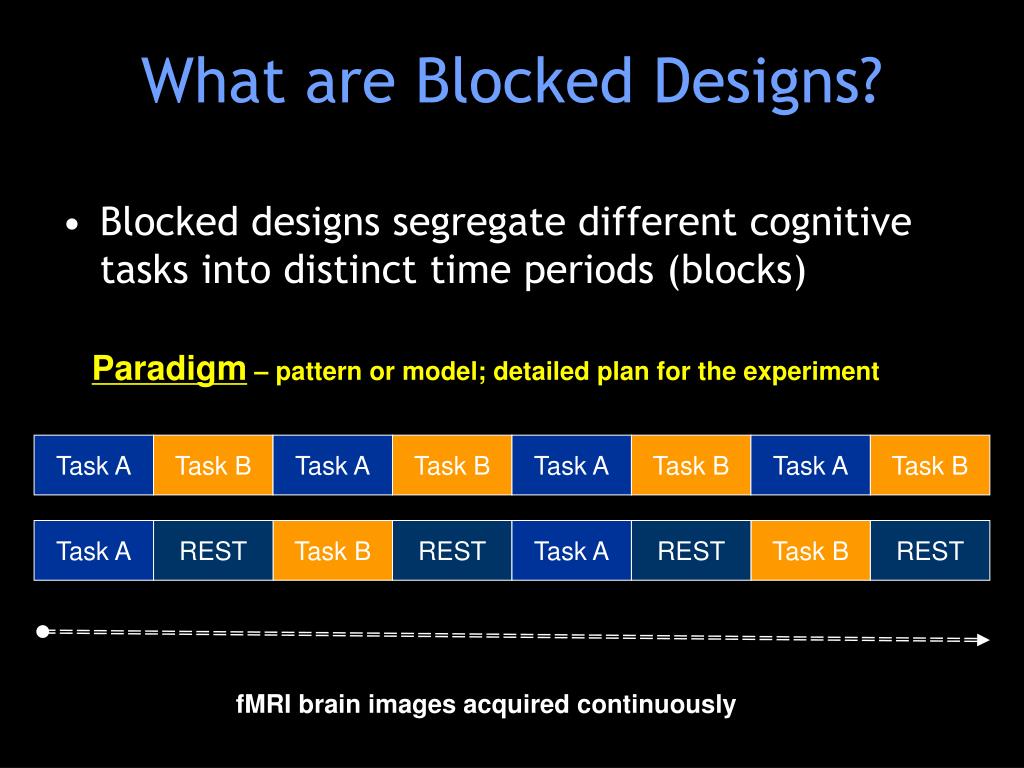
For a complete block design, we would have each treatment occurring one time within each block, so all entries in this matrix would be 1's. For an incomplete block design, the incidence matrix would be 0's and 1's simply indicating whether or not that treatment occurs in that block. It looks like day of the week could affect the treatments and introduce bias into the treatment effects, since not all treatments occur on Monday. We want a design with 3 blocking factors; machine, operator, and day of the week. The choice of case depends on how you need to conduct the experiment. If you are simply replicating the experiment with the same row and column levels, you are in Case 1.
Block a few of the most important nuisance factors
Both types of variation must be controlled if bias and irreproducibility are to be avoided. Hence, a block is given by a locationand an experimental unit by a plot of land. In the introductory example, a blockwas given by an individual subject. By placing the individuals into blocks, the relationship between the new diet and weight loss became more clear since we were able to control for the nuisance variable of gender. In this case, you would run the oven 40 times, which might make data collection faster. Each oven run would have four loaves, but not necessarily two of each dough type.
An Example: Blocking on gender
Since the first three columns contain some pairs more than once, let's try columns 1, 2, and now we need a third...how about the fourth column. If you look at all possible combinations in each row, each treatment pair occurs only one time. With our first cow, during the first period, we give it a treatment or diet and we measure the yield. Obviously, you don't have any carryover effects here because it is the first period. However, what if the treatment they were first given was a really bad treatment? In fact in this experiment the diet A consisted of only roughage, so, the cow's health might in fact deteriorate as a result of this treatment.
Between two stools: preclinical research, reproducibility, and statistical design of experiments
This carryover would hurt the second treatment if the washout period isn't long enough. The measurement at this point is a direct reflection of treatment B but may also have some influence from the previous treatment, treatment A. Together, you can see that going down the columns every pairwise sequence occurs twice, AB, BC, CA, AC, BA, CB going down the columns. The combination of these two Latin squares gives us this additional level of balance in the design, than if we had simply taken the standard Latin square and duplicated it. The simplest case is where you only have 2 treatments and you want to give each subject both treatments.
Statistical Analysis of the Latin Square Design
Consider a factory setting where you are producing a product with 4 operators and 4 machines. Then you can randomly assign the specific operators to a row and the specific machines to a column. The treatment is one of four protocols for producing the product and our interest is in the average time needed to produce each product. If both the machine and the operator have an effect on the time to produce, then by using a Latin Square Design this variation due to machine or operators will be effectively removed from the analysis. Unfortunately, most authors appear to use the in-valid “Randomisation to treatment group” (RTTG) design, shown in Fig. In this design, subjects are randomly assigned to physical treatment groups but the order in which the experiment is done is not randomised.
Model
This is a simple extension of the basic model that we had looked at earlier. The row and column and treatment all have the same parameters, the same effects that we had in the single Latin square. In a Latin square, the error is a combination of any interactions that might exist and experimental error. If this point is missing we can substitute x, calculate the sum of squares residuals, and solve for x which minimizes the error and gives us a point based on all the other data and the two-way model. We sometimes call this an imputed point, where you use the least squares approach to estimate this missing data point.
Reliability optimization of process parameters for marine diesel engine block hole system machining using improved ... - Nature.com
Reliability optimization of process parameters for marine diesel engine block hole system machining using improved ....
Posted: Tue, 09 Nov 2021 08:00:00 GMT [source]
They may also be genetically identical if an inbred strain is used. So the research environment may be the main source of inter-individual variation. I think most of the time it’s just a matter of convention, likely proper to each field. I think that in medical context, in a two factors anova one of the factors is almost always called "treatment" and the other "block".
AP Statistics:Table of Contents
Gutenberg 16.4 Introduces Experimental Auto-Inserting Blocks – WP Tavern - WP Tavern
Gutenberg 16.4 Introduces Experimental Auto-Inserting Blocks – WP Tavern.
Posted: Thu, 10 Aug 2023 07:00:00 GMT [source]
Although the sex of the patient is not the main focus of the experiment—the effect of the drug is—it is possible that the sex of the individual will affect the amount of weight lost. This is a paired design, which is the most simple form of randomized complete block design. The widespread use of the statistically in-valid RTTG design, which is not found in any reputable textbooks, may account for a substantial fraction of the observed irreproducibility. People, places, species and scientific procedures have names which can be used to identify and describe a subject or a procedure. Experimental designs also have names; “Completely randomised”(CR), “Randomised block”(RB), “Latin square”, “Matched pairs” etc.
Nature methods: Points of significance - Blocking
For example, the first ten papers had been published in 2017, 17, 19, 19, 19, 18, 15, 16, 19, and 18. And the first two digits of their identification numbers were 55, 55, 66, 65, 66, 59, 71, 61, 46 and 48. In order to introduce a random element to the selection, only papers with an even identification number were used. For example, suppose each individual has a certain amount of innate discipline that they can draw upon to lose more weight. Since discipline is hard to measure, it’s not included as a blocking factor in the study but one way to control for it is to use randomization.
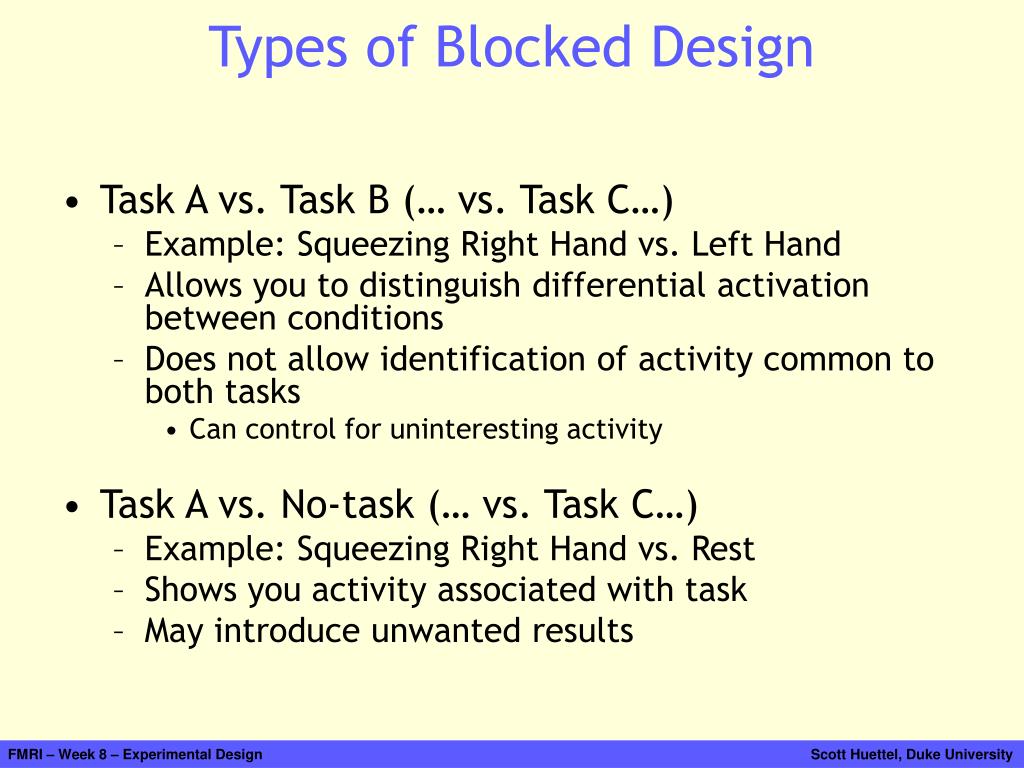
A special case is the so-calledLatin Square design where we have two blockfactors and one treatment factor having \(g\) levels each (yes, all of them!).Hence, this is a very restrictive assumption. In a Latin Square design, eachtreatment (Latin letters) appears exactly once in each row and once ineach column. A Latin Square design blocks on both rows and columnssimultaneously. If we ignore the columns of a Latin Square designs, the rows form anRCBD; if we ignore the rows, the columns form an RCBD. Many times there are nuisance factors that are unknown and uncontrollable (sometimes called a “lurking” variable).
Statisticians involved in clinical trials sometimes write about “randomising patients to treatment groups”. Clearly, they are using the second definition as there are no physical groups in a clinical trial. But if scientists assign their animals to physical groups (“….things together”), they will be using the invalid “Randomisation to treatment group” (RTTG) design shown in Fig. If two or more animals are housed in the same cage they will interact, this can increase physiological variation.


No comments:
Post a Comment